

Introduction
Imagine watching a currency pair like EUR/USD tick up by just 0.1% and turning that into real gains—welcome to the dynamic world of Forex. Forex, or foreign exchange, is the largest financial market globally, where traders buy and sell currencies to profit from rate changes. Understanding Forex currency rates is crucial because they reflect economic health, geopolitical events, and central bank policies, influencing everything from international trade to personal investments.
This article dives deep into Forex basics, live updates, and analysis to equip you with practical knowledge. You'll gain insights into how rates work, real-time data on major pairs, effective Forex strategies, and even spread betting Forex tips. By the end, you'll be ready to navigate the market confidently, whether you're a beginner or seasoned trader, and apply betting tips to enhance your approach.
Understanding Forex Currency Rates
Forex currency rates represent the value of one currency against another, quoted in pairs like EUR/USD. These rates fluctuate constantly due to supply and demand, driven by factors such as interest rates, inflation, and economic data.
In Forex, the base currency is the first in the pair, and the quote currency is the second. For example, if EUR/USD is 1.05, it means 1 euro buys 1.05 US dollars. Traders speculate on whether rates will rise or fall to make profits.
Major pairs dominate Forex trading, accounting for about 85% of volume. Examples include USD/JPY, where the US dollar is paired with the Japanese yen, often influenced by US Fed decisions.
Key Factors Influencing Forex Rates
Economic indicators play a big role in Forex rates. GDP growth, employment figures, and inflation reports can cause sharp movements. For instance, strong US nonfarm payrolls data might strengthen the dollar.
Geopolitical events also impact Forex. Trade tensions or elections can lead to volatility, as seen in recent US policy shifts affecting USD/MXN rates around 18.50.
Central banks like the Fed or ECB adjust interest rates, directly affecting currency strength. Higher rates attract investors, boosting the currency's value in Forex markets.
How to Read Forex Quotes
Forex quotes show bid and ask prices. The bid is what buyers pay, the ask is what sellers want. The difference is the spread, a key cost in trading.
For live examples, consider GBP/USD at 1.25 bid and 1.251 ask. You'd sell at 1.25 or buy at 1.251, with the spread being 0.001 or 1 pip.
Pips measure rate changes in Forex. Most pairs use four decimal places, so a 0.0001 move is one pip, crucial for calculating profits.
Live Updates on Major Forex Pairs
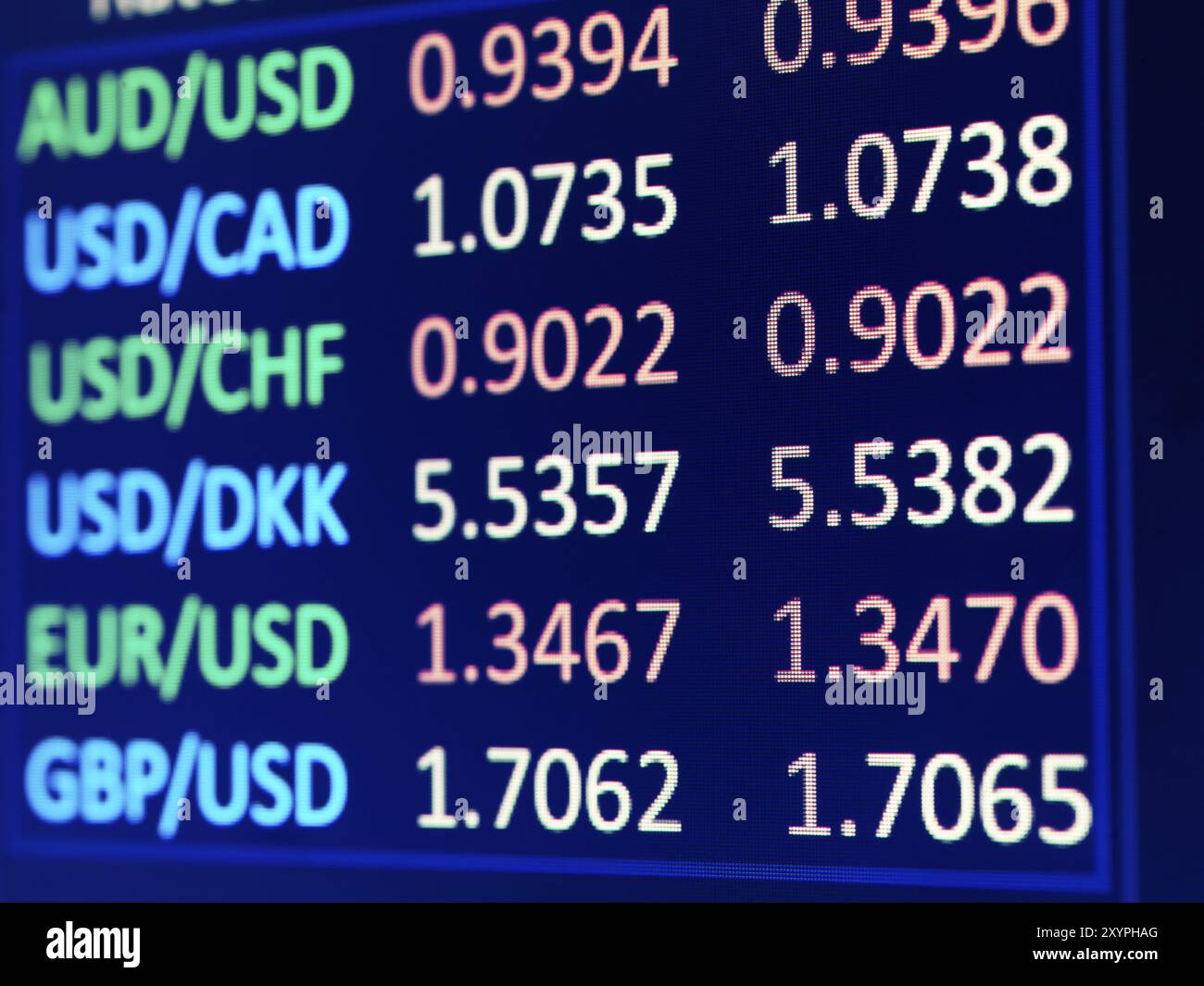
Staying current with Forex rates is essential for timely decisions. As of November 2025, the market shows resilience amid Fed rate adjustments.
EUR/USD hovers around 1.0719, facing resistance at 1.0777 after recent Fed cuts to 4.00%-4.25%. This pair reflects Eurozone vs. US economic divergence.
GBP/USD trades near 1.30, influenced by UK inflation at 2.6% YoY, above the BoE's 2% target. Watch for BoE policy shifts impacting this pair.
USD/JPY stands above 154.00, driven by Bank of Japan uncertainties and US yield advantages. Asian currencies remain active with global export growth.
Current Trends in Other Pairs
AUD/USD sits at about 0.65, affected by commodity prices and RBA moves. Commodity-linked pairs like this often react to global demand.
USD/CHF is around 0.87, seen as a safe-haven play during volatility. Swiss franc strength ties to neutral policy.
NZD/USD, or the Kiwi, trades near 0.60, influenced by dairy exports and RBNZ rates. Keep an eye on agricultural data.
Daily Volatility and Updates
Forex markets saw a 15.2% volume increase from October 2024 to April 2025. London handles 37% of trades, making European sessions peak times.
Use tools like economic calendars for updates. Nonfarm payrolls or CPI releases can swing rates by 50-100 pips instantly.
For real-time tracking, platforms like Investing.com or OANDA provide live feeds, helping traders spot opportunities in Forex.
Analysis Techniques for Forex Trading
Analyzing Forex rates combines technical and fundamental approaches to predict movements. Technical analysis uses charts and indicators for patterns.
Fundamental analysis examines economic data. For example, US CPI at 2.7% YoY in November suggests sticky inflation, supporting USD strength.
Sentiment analysis gauges market mood via tools like the Commitment of Traders report, showing trader positions.
Technical Analysis Tools
Moving averages smooth price data to identify trends. A 50-day MA crossing above a 200-day signals a bullish Forex trend.
RSI measures overbought/oversold conditions. Above 70 suggests selling, below 30 buying opportunities in Forex pairs.
Fibonacci retracements help find support/resistance levels. For EUR/USD, a 61.8% retrace from highs could indicate reversal points.
Fundamental Analysis in Action
Compare economies: US growth at 2.8% vs. Eurozone's 0.7% explains EUR/USD weakness.
Statistics show USD/JPY rose from 13.5% to 14.3% of global turnover by 2025. This highlights yen's role in carry trades.
Actionable tip: Track Fed projections for 2025 rate cuts, potentially weakening USD if more than expected.
Combining Techniques for Better Insights
Use technicals for entry points, fundamentals for direction. For instance, if news boosts USD, confirm with chart breakouts.
In 2025, automation trends mean algorithms handle 20% more trades, aiding precise analysis.
Practice on demo accounts to refine your Forex analysis skills before going live.
Forex Strategies for Success
Effective Forex strategies guide trading decisions, balancing risk and reward. Beginners should start with simple plans.
Trend trading follows market direction. Identify uptrends with higher highs and lows, entering buys on pullbacks.
Swing trading captures short-term swings. Hold positions for days, using support/resistance for targets.
Beginner-Friendly Forex Strategies
Scalping involves quick trades for small pips. Ideal for volatile pairs like GBP/USD, but requires discipline.
Range trading works in sideways markets. Buy at support, sell at resistance, with stops outside the range.
Carry trade borrows low-rate currencies to buy high-yield ones, like selling JPY to buy AUD.

Advanced Forex Strategies
Breakout strategy: Trade when price breaks key levels, confirmed by volume. Set stops below breakout point.
Mean reversion assumes prices return to averages. Use Bollinger Bands to spot deviations.
News trading capitalizes on releases. For example, trade post-Fed announcements, but beware slippage.
Incorporating Betting Tips into Strategies
Forex betting tips emphasize risk management: Never risk more than 1-2% per trade.
Use stop-losses religiously. In volatile 2025 markets, they protect against sudden shifts.
Diversify pairs: Mix majors with exotics for balanced exposure in Forex strategies.
Spread Betting Forex Explained
Spread betting Forex lets you speculate on rate movements without owning currencies. Bet on whether a pair rises or falls, with stakes per point.
It's tax-free in some regions like the UK, making it popular. For EUR/USD, if quoted 1.0500-1.0502, bet £10 per pip on rise or fall.
Leverage amplifies gains but risks losses. Start small to learn spread betting Forex dynamics.
Pros and Cons of Spread Betting Forex
Pros: No commissions, flexible sizing, and access to 24/5 markets. Ideal for short-term bets.
Cons: High leverage can lead to quick losses; not available everywhere due to regulations.
Compared to traditional Forex trading, spread betting offers simpler tax treatment but similar risks. Many brokers provide both, allowing comparisons.
Reviews show platforms like IG or CMC Markets excel in spread betting Forex tools, with tight spreads and education.
Tips for Spread Betting Forex
Choose volatile pairs for bigger moves, but use limits. Combine with Forex strategies like trend following for better odds.
Monitor margins: Ensure account balance covers potential losses in spread betting Forex.
In 2025, with market growth at 10.6% CAGR, spread betting remains a key tool for agile traders.

Conclusion
Forex currency rates are the heartbeat of global finance, with live updates revealing opportunities in pairs like EUR/USD and USD/JPY. We've explored how rates work, current trends amid 2025's $9.6 trillion daily turnover, and analysis techniques blending technicals and fundamentals.
Key Forex strategies, from trend trading to scalping, paired with betting tips, empower informed decisions. Spread betting Forex adds a versatile layer, though with risks to manage.
Dive into Forex today—start with a demo account, apply these insights, and watch your skills grow. Share your thoughts in the comments: What's your favorite Forex pair? Like and share if this helped, and subscribe for more updates!
FAQ
Disclaimer: The content of this article is for informational purposes only and does not constitute financial advice. We are not financial advisors. Always consult a certified financial professional before making investment decisions.